Key takeaways:
- Online betting has gone mainstream, moving from casinos and office pools to phones and daily routines.
- As betting becomes easier to access, it can start to overlap with other financial priorities, including long-term goals like investing.
- Gambling is about hoping an outcome goes your way; investing is about buying and owning real companies over time.
- Both can coexist without tradeoffs when betting stays entertainment and money meant for the future is invested.
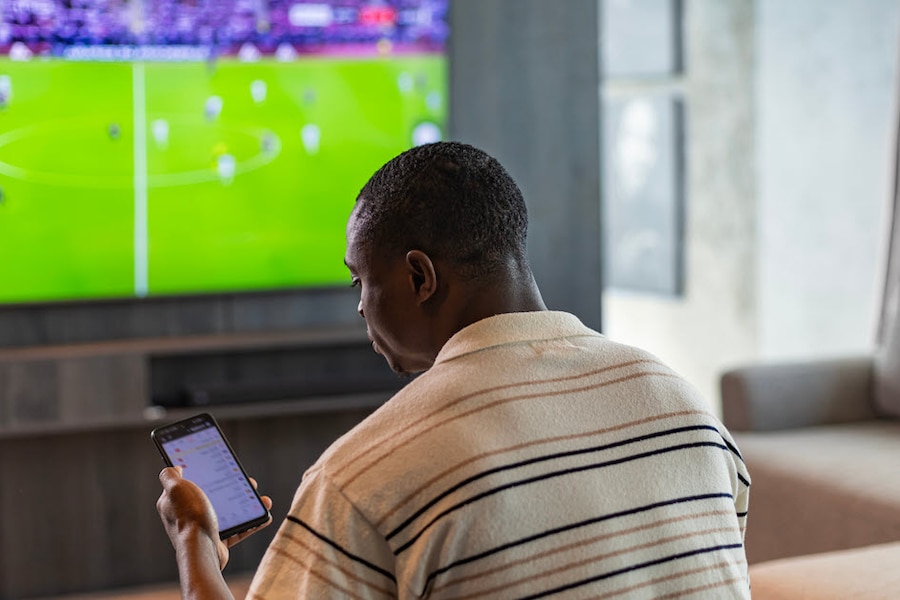
What used to be a casual office pool or a weekend of blackjack in Las Vegas has become more commonplace as online betting moves from casinos to personal screens. Fueled by increased legalization, the rise of prediction markets, and gamified mobile platforms, online betting has exploded into a fast-growing, billion-dollar industry in the U.S., with access to online casinos in players' pockets.
According to research published by Siena University, 22% of Americans have an active account on an online sportsbook. For men ages 18-49, that number increases to 48%.
For many people, gambling is a form of entertainment. But as access has grown, it can sometimes begin to overlap with other financial priorities—including investing for the future.
How popular is online gambling?
As gambling sites have evolved, the scope of what bettors can wager on has significantly expanded.
"You can bet on literally anything nowadays," says Brian Hatch, host of ALL IN: The Addicted Gambler's Podcast. "It used to be placing a couple of small bets or guessing who would win the game. Now you can bet on what color Gatorade will be poured on the winning coach."
Alongside sports betting, prediction markets have surged in popularity. On sites like Kalshi and Polymarket, users can weigh in on all kinds of real-world events, ranging from the next president of the United States to Taylor Swift's album sales. Just this year, more than $23 million was tied to predictions about where professional basketball player Giannis Antetokounmpo would be traded.
Some see these platforms as a different way to engage with real-world outcomes, rather than traditional betting. As they grow in visibility, they're becoming part of a broader shift in how people think about money, risk, and decision-making.
On top of what you can bet on, the integration of mobile betting apps has significantly impacted how and where gamblers bet. "You don't have to drive anywhere," explains Dr. Jim Whelan, clinical health professor at the University of Memphis and director of the Tennessee Institute for Gambling Education and Research. "You don't have to plan a trip [to the casino]. You just pick up your phone. So sports betting is somewhat synonymous with access."
Sites like DraftKings Sportsbook are available in 26 U.S. states and advertise on social media that, "jumping in has never been easier," with every potential wager just a couple taps away. Celebrities like Kevin Hart and Shaquille O'Neal have partnered with these sportsbooks, promoting them to their large audiences through advertising campaigns and sign-up incentives.
According to ESPN, the sports betting industry earned a record-setting $16.96 billion in 2025, underscoring just how quickly it's become part of mainstream entertainment.
What are the risks of gambling?
Placing a bet on a basketball game isn't inherently risky for most people. For some, gambling is simply another form of entertainment—similar to spending money on a concert, a night out, or a vacation—with the added possibility of a payout.
At the same time, like any financial decision, outcomes can vary. While wins are part of the appeal, losses are also common, and the data shows that many bettors end up behind over time. How gambling fits into someone's financial life often comes down to how much they spend, how often they participate, and how that spending compares to other priorities.
Dr. Shane Kraus, an associate professor of psychology at the University of Nevada, Las Vegas, and director of the school's Behavioral Addictions Lab, says preoccupation is one of the earliest warning signs of a gambling problem. That fixation is often fueled by the excitement of a potential jackpot—the belief that the next big win is just around the corner.
Podcast host Brian, who struggled with a gambling addiction himself, says he now realizes how much he lost when he was gambling. "Just as much as the money I lost, I also lost time to put into my relationships and my passions," he says.
That broader picture also includes where the money is coming from. Research suggests that in some cases, people fund bets with dollars that might otherwise go toward saving or investing. Over time, those tradeoffs can shape long-term outcomes—particularly when short-term spending consistently takes priority over longer-term goals.
But gambling isn't the only area where tradeoffs show up. Investing also involves uncertainty, including the potential for loss, and requires decisions about risk, time horizon, and priorities. The difference isn't whether one carries risk and the other doesn't—it's how each fits into a person's overall plan.
For many, the key question isn't whether to participate at all, but how to balance entertainment with long-term financial goals—so that one doesn't unintentionally crowd out the other.
What is the difference between gambling and investing?
The key difference between gambling and investing is hoping versus owning.
Every wager is a trade between known odds and uncertain outcomes. The odds rarely exceed a coin flip, and they're structured to favor the house. Add prop bets or parlays, and what looks like strategy is often just hope multiplied—more ways for the bet to miss.
On the flip side, investing isn't a bet on an outcome—it's a purchase. As Jonathan Craig, head of retail investing at Schwab, emphasized in a recent article, when you buy stocks in a diversified portfolio, you're buying pieces of real, public companies and participating in their potential future profits and growth over time. That ownership still comes with uncertainty, including the risk of loss. But historically, longer investment horizons have been associated with more consistent outcomes than short-term wagers.
When betting feels like investing—but isn’t
The line between gambling and investing can blur, especially in a culture that celebrates risk. Schwab experts Liz Ann Sonders and Kevin Gordon unpack why the two aren’t the same and why the distinction matters more than ever.
How do you know when a bet is worth it?
Responsible betting is possible. But it depends on clear boundaries—not just around how often you bet, but where the money comes from and what it's competing with. Understanding the difference between gambling for entertainment and investing for the future is what keeps one from quietly crowding out the other.
"The key thing to do is to limit how you access your money or how much time you're going to dedicate to something," says Dr. Whelan. "Understanding how much you're spending and where it's coming from is a crucial tool."
For some people, that means betting occasionally with money they can afford to lose. For others, the only healthy option is not gambling at all. What matters most is investing what's meant for the future. Because when it comes to financial decision‑making, owning still beats hoping, and long‑term priorities should come before short‑term fun.
The line may be blurring, but the outcomes are not.
More from Charles Schwab

Teens vs. Parents: Different generations’ thoughts on investing

The RIA industry is just getting started.