
Not long ago, owning bitcoin (or any digital asset, really) was treated like a punchline. Cryptocurrency investors were stereotyped as loud, young, and impatient. But as crypto has become a more popular investing strategy, the conversation about its long-term feasibility, as well as its investor profile, is changing.
As Schwab's 2025 Modern Wealth Survey found, nearly half of American investors have previously owned or currently own some form of cryptocurrency. It's made payments faster and cheaper, and international payments more accessible. While traditional portfolios may lean heavily on stocks and bonds, some see digital assets as a fresh way to diversify investments. As a result, cryptocurrency is steadily moving from the margins of investing into the realm of portfolio diversification.
"Early on, crypto was very short-term," says Joe Vietri, Schwab's head of digital assets. "As people understood the use cases and what problems it's solving, that shifted toward a long-term view. People are now viewing and owning digital assets through the lens of portfolio diversification."
Crypto's investor base is changing, and so is how they buy in
A major shift in the past few years is how investors can participate in the crypto market, which has also led to a shift in who is getting involved. For many, crypto exposure no longer means navigating unfamiliar platforms or DIY security from scratch. Now mainstream products and a more developed digital infrastructure have made it easier for investors to integrate digital assets into their investment portfolio.
In January 2024, the Securities and Exchange Commission (SEC) approved the first set of spot bitcoin exchange-traded products (ETPs) in the United States. The decision marked a significant milestone for the financial industry, as potentially wary investors gained direct price exposure to cryptocurrency through familiar, regulated financial products like traditional brokerage and 401(k) accounts. While bitcoin remains a volatile asset, the approval was widely viewed as an important step toward broader institutional participation and increased legitimacy for cryptocurrency within traditional financial markets.
"When you see major brokerages and asset managers begin to offer crypto ETPs, it shows that crypto has definitely evolved past its perception as a wild west tech gamble," explains Joe. "Instead, it's an emerging asset class that people realize they've got to consider."
For an asset class that once felt exclusive to technophiles, ETPs are helping traditional investors get their first taste of cryptocurrency. Schwab's 2025 ETFs and Beyond Study found that 49% of investors in exchange-traded funds (ETFs), a type of ETP, strongly agreed that ETFs allowed them to invest in more niche or targeted asset classes or strategies like cryptocurrency.
"Age and generational mix in the early waves of crypto were dominated by younger, more tech-savvy investors," Joe notes. "Now, we're seeing interest from Gen X and even some boomers."
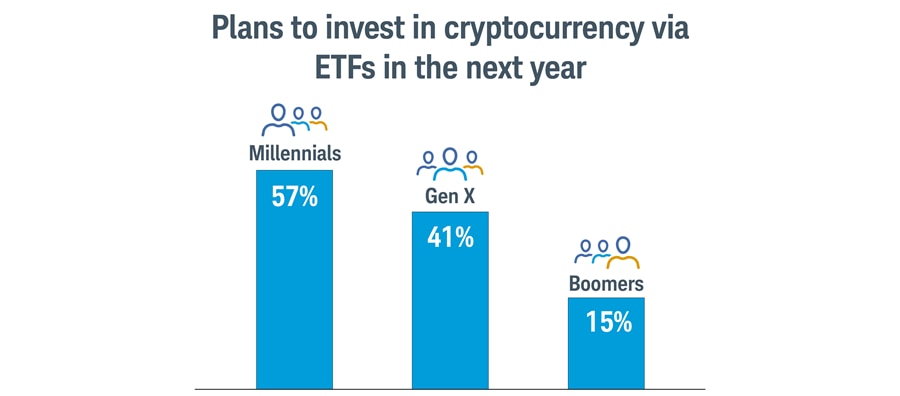
Of Gen X ETF investors, 41% plan to invest in cryptocurrency via ETFs over the next year. For Millennials, it's more than half.
2025 Charles Schwab ETFs and Beyond Study
Simply put, the institutional backing of crypto ETPs is creating a new wave of crypto investing—one that traditional investors are more willing to give a chance.
The big shift: optimism, diversification, and planning
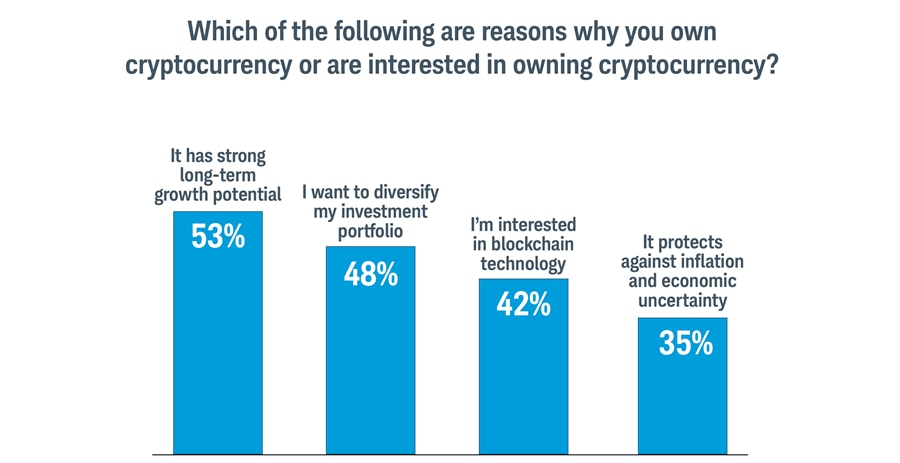
Schwab’s 2025 Modern Wealth Survey suggests that many crypto investors see digital assets as part of a long-term plan rather than a short-term lottery ticket. According to the study, the top reasons investors own crypto are its strong long-term growth potential (53%) and its ability to diversify their investment portfolio (48%), followed by an interest in blockchain technology (42%).
2025 Charles Schwab Modern Wealth Survey
This data illustrates a shift in how crypto is perceived and the role it plays in investors' portfolios.
"The people who truly understand the utility of crypto don't think of it as a trading vehicle—they think of it as a new asset class," says Joe. "Clients are applying the same diversification principles they use everywhere else."
Education and support to empower smarter crypto investing
Like any investment strategy, crypto still involves volatility, and some investors are drawn to it for that very reason. But not all crypto investors are swinging for the fences without a plan. Investors are becoming more intentional and weighing potential upsides, acknowledging uncertainty, recognizing that not all cryptocurrency investments are the same and integrating digital assets into clearly defined investment strategies.
"We have some active clients who are very short-term in nature and love volatility. And crypto and volatility are like peanut butter and jelly," says Joe. "But the majority of our clients at Schwab fall into a different camp. They take a longer-term view and look at where crypto fits into their traditional way of thinking about asset allocation for goals-based investing."
As more investors explore alternative investments like crypto, and as Schwab plans for its own spot crypto launch later this year, Joe emphasizes that investor education becomes essential. Providing the confidence and context needed to support clients thoughtfully as crypto enters financial conversations is non-negotiable.
"I always tell people: I'm not here to convince you of cryptocurrencies," he says. "I'm here to inspire you to go learn more and make your own decision. You can be sure that everything we launch is going to be rooted in education, world-class support, and having someone on the other end of the phone who can actually talk to you should you need it."
Want to dig deeper?
More from Charles Schwab

Who gets your crypto when you’re gone?

The tradeoffs between betting and investing