Key takeaways:
- Leslie Killgore passed on her decades-long business to her son.
- Careful, gradual succession planning helped ensure families could continue working with Schwab across generations.
- As younger investors enter the picture, Leslie’s son Joseph is positioned to guide them with confidence and continuity.
As Joseph Killgore stepped into his mother’s role, the transition reflected something bigger than a business changing hands. It was one generation preparing the next to serve families doing the same.
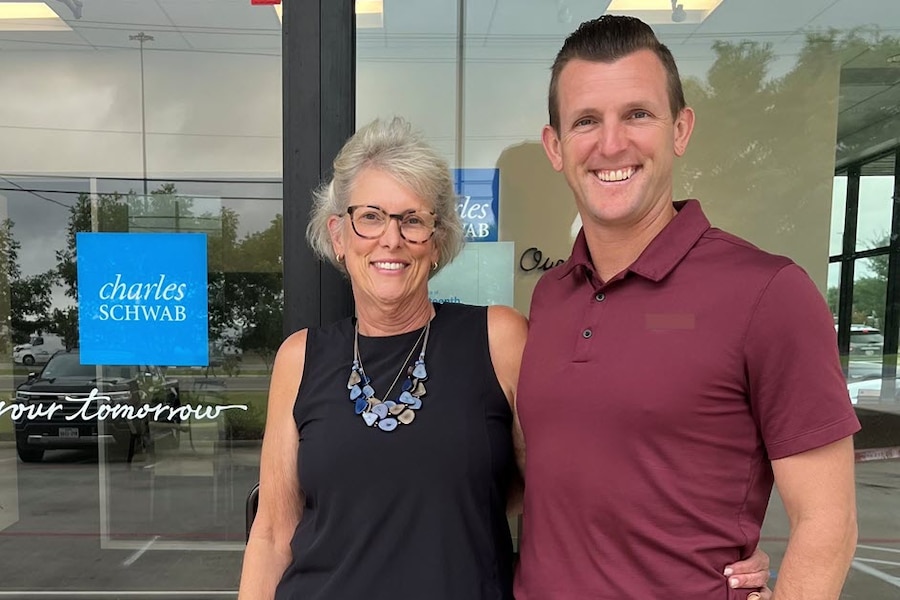
Long before ownership officially changed hands, Joseph and his mother, Leslie Killgore—a longtime Financial Consultant and Schwab franchise branch owner in Greenville, TX—positioned the transition as a passing of the baton. The goal was to ensure that the people Leslie began working with decades ago could confidently bring their children and grandchildren into the conversation, knowing her own next generation was ready to serve theirs.
"This wasn't a takeover," Joseph says. "It was a continuation."
Building client relationships designed to last
Leslie spent 41 years in the industry, working her way from assistant to licensed professional to franchise branch owner. Over time, she built something rare: a practice rooted in trust deep enough to span entire lifetimes.
Clients relied on her presence through loss, uncertainty, major transitions, and long-term planning that stretched well beyond any single moment or milestone.
"Even closest friends and family members don't always know the details of their loved ones' finances," explains Leslie. "I've appreciated the confidence and trust clients have placed in me through the years and can honestly say that their joys have been my joys and their sorrows, my sorrows."
That approach laid the groundwork for a deep trust that allows families to think in generations, not just years.
Planning a gradual transition before it was necessary
About five years ago, Leslie experienced a series of health crises. When she recovered, her thinking shifted.
"I thought about how hard it would be for my clients as well as our team if I left one day and never came back," she says. "That's when I felt it was time to prepare for Joseph to take over my legacy clients as well as the ownership of the branch."
What followed was a deliberately slow, thoughtful transition. Leslie reduced her schedule so Joseph could manage the branch day to day while she was away. At the same time, they began working with Schwab to start the process of transferring ownership of the branch.
The succession plan unfolded over more than a year, giving Joseph space to make decisions, shape vision, and learn the weight of responsibility before anything was formalized.
A transition timed for both the next advisor and the next era of clients
When the transition finally became official, it was understated by design. The paperwork was signed with a longtime client in the office serving as official witness to the handoff.
"It felt smooth," Joseph says. "Because of how well she prepared me, the only thing that really changed was my title."
What shifted was his awareness of what the role carried.
"The weight of taking care of people," he says. "Employees. Clients. Families. That's what you carry forward."
Helping new investors find a starting point
Today, much of the branch's work happens at the intersection of generations. Parents refer adult children. Grandparents invite grandchildren into meetings. Sometimes everyone sits together. Sometimes the transition happens gradually.
Joseph notices that what younger investors often bring isn't a lack of ambition, it's uncertainty about how to start.
"They don't know what questions to ask," he says. "They know what they want—retirement, a house, independence—but they don't know how to turn that into a plan."
That uncertainty is becoming more common. Nearly one third of new to firm retail households at Schwab are Gen Z—investors just beginning to figure out what financial security even means. Helping them move from generic benchmarks to personal goals has become a growing part of the work, and a clear extension of Leslie's original vision: a business designed so families could bring the next generation forward without starting from scratch.
Continuing a legacy of trust across generations
As Joseph looks ahead, growth isn’t the primary measure of success. What matters most is seeing his mother’s clients and their families through the next chapter.
“I want to finish well for the people she started with in the ’80s and ’90s,” he says. “They trusted my mother. She entrusted them to me. My role is to help them pass that trust to the next generation.”
More from Charles Schwab

The tradeoffs between betting and investing

Why cash can feel like fun money to young spenders.